 Skip to content
TANKLESS CONVERSION — TAX CREDIT ELIGIBLE
WOW. THE BEST SPECIAL ON A NEW WATER HEATERTankless Water Heater Service in Riverside County, CA
A tankless heater makes hot water on demand instead of keeping a tank warm around the clock, and that changes what the installation has to get right. Gas capacity, vent routing, mounting position and access for servicing all matter more than the badge on the front. Rooter King Plumbing sizes the unit to the household’s real peak draw, fits it properly, and sets up the descaling that keeps the heat exchanger clear in hard-water country.
Get in Touch For A Tankless Conversion!
Repair or replace is the first call we make on a tankless unit, and it almost always comes down to the heat exchanger. A packed inlet screen, a tired igniter, a flame rod that needs cleaning, a failed flow sensor or a unit that has simply gone too long without descaling are all repairs worth doing. A heat exchanger that has split, or scaled solid from end to end, is not. We will tell you which of those you actually have, and what a replacement would involve, including the vent work and any permit the city wants pulled.
We are not here to sell you a unit you do not need, or to bury the fault in jargon. Our licensed technicians diagnose what the tankless system is actually doing, explain the options in plain English, and get hot water moving through the house again safely. Whether that ends in a descaling service, a replaced igniter or flow sensor, a corrected vent run, or a full tankless installation, Rooter King gives you transparent pricing and workmanship that holds up in Inland Empire hard water.

Tankless Water Heater Services We Offer
Recognizing When Your Tankless Water Heater Needs Repair
Most homeowners assume that as long as hot water eventually reaches the tap, the tankless heater is fine. On-demand units rarely quit outright, though. They stumble first, and they stumble in ways that are easy to live with for a season: a burner that has to try twice to light, a temperature that wanders halfway through a shower, a fault code that clears itself if you cycle the power. Catching the unit at that stage is usually the difference between a descaling visit and a replaced heat exchanger.
If your tankless heater is doing any of the following, it is worth a professional diagnostic before the fault turns into a replacement:
Water or Condensate Under the Unit: Water under a wall-hung tankless heater is never normal. It may be a weeping isolation valve, a failed gasket where the exchanger meets the manifold, or condensate that is not draining the way the venting intends it to. None of those improve on their own, and the cabinet they are dripping into is full of control electronics that do not tolerate moisture.
Temperature That Wanders Mid-Shower: If the shower runs hot, then cool, then hot again, the unit is struggling to modulate against the flow it is being handed. That points at a scaled heat exchanger, a flow sensor reading badly, a partly blocked inlet screen, or a fixture drawing too little water to keep the burner lit at all.
Clicking, Rumbling, or a Burner That Hunts: A tankless heater should light cleanly and then run steadily. Repeated clicking before ignition, a rumble from inside the cabinet, or a burner that keeps cutting out and relighting all point the same direction: scale inside the heat exchanger, a flame rod dirty enough to lose sight of the flame, or an air supply being choked somewhere along the vent run.
Discolored or Rusty Water: Discoloured or metallic-tasting water on the hot side of a tankless system does not mean a tank is rusting through, because there is no tank here. It usually means mineral debris is breaking loose inside the heat exchanger, or that the fittings and manifold are corroding. Either way it is a signal to descale and inspect the exchanger rather than to wait and see.
Low Hot Water Pressure: If cold pressure through the house is normal but the hot side has dropped to a trickle, a tankless system nearly always has a restriction ahead of the burner: the inlet filter screen packed with grit, scale narrowing the exchanger passages, or a service valve that was never fully reopened after the last visit.
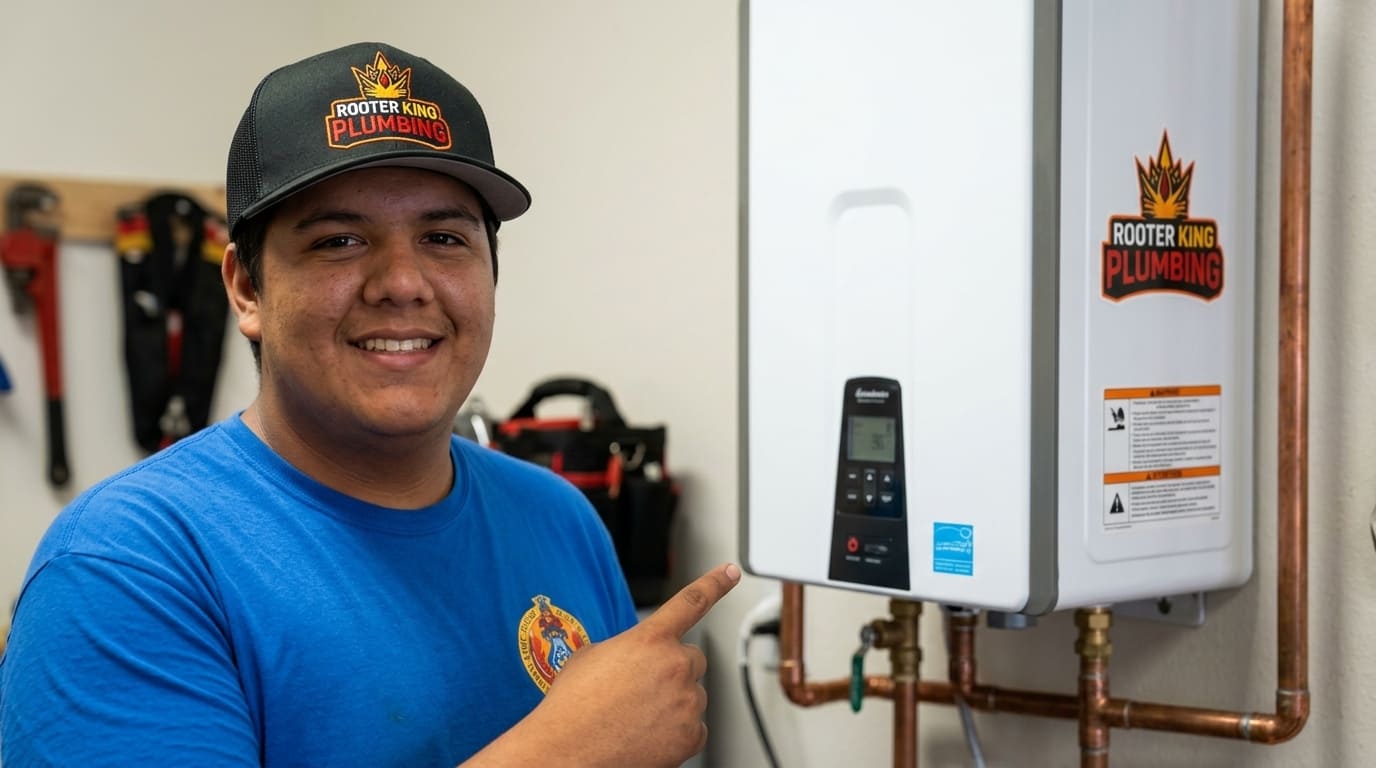
Professional Tankless Water Heater Installation and Conversion
No appliance lasts forever. A standard, traditional tank-style water heater has an average life expectancy of about 8 to 12 years, depending heavily on the local water quality and how well it has been maintained. When a tank eventually rusts through or the internal structural fatigue becomes too great, repairs are no longer an option. The unit must be completely replaced.
Replacing a water heater is a heavy, dangerous, and highly technical job that should never be attempted as a weekend DIY project. A standard 50-gallon tank can weigh over 150 pounds when empty, and manipulating the high-voltage 220v electrical lines or the volatile natural gas lines requires strict adherence to safety protocols.
When you hire Rooter King for a water heater installation, we handle the entire process from start to finish with absolute precision:
Rigorous Testing: Before we pack up our tools, we fire up the new unit, test the gas lines for microscopic leaks, verify the water pressure, and make sure the thermostat is set to a safe, energy-efficient temperature (typically 120°F to prevent scalding).
Safe Removal and Disposal: We safely drain the 50 gallons of water from your old unit, properly disconnect the hazardous utility lines, and haul the heavy, rusted tank away for environmentally responsible recycling so you never have to lift a finger.
Code-Compliant Installation: California building codes are incredibly strict, especially regarding seismic safety. We make sure your new unit is installed with heavy-duty earthquake strapping, properly sized thermal expansion tanks, and perfectly pitched exhaust venting to prevent deadly carbon monoxide from entering your home.
Proper Sizing: We don’t just guess what size you need. We calculate your household’s peak hot water demand to make sure we install a unit with the correct First Hour Rating (FHR) so your family never has to fight over the last drop of hot water.
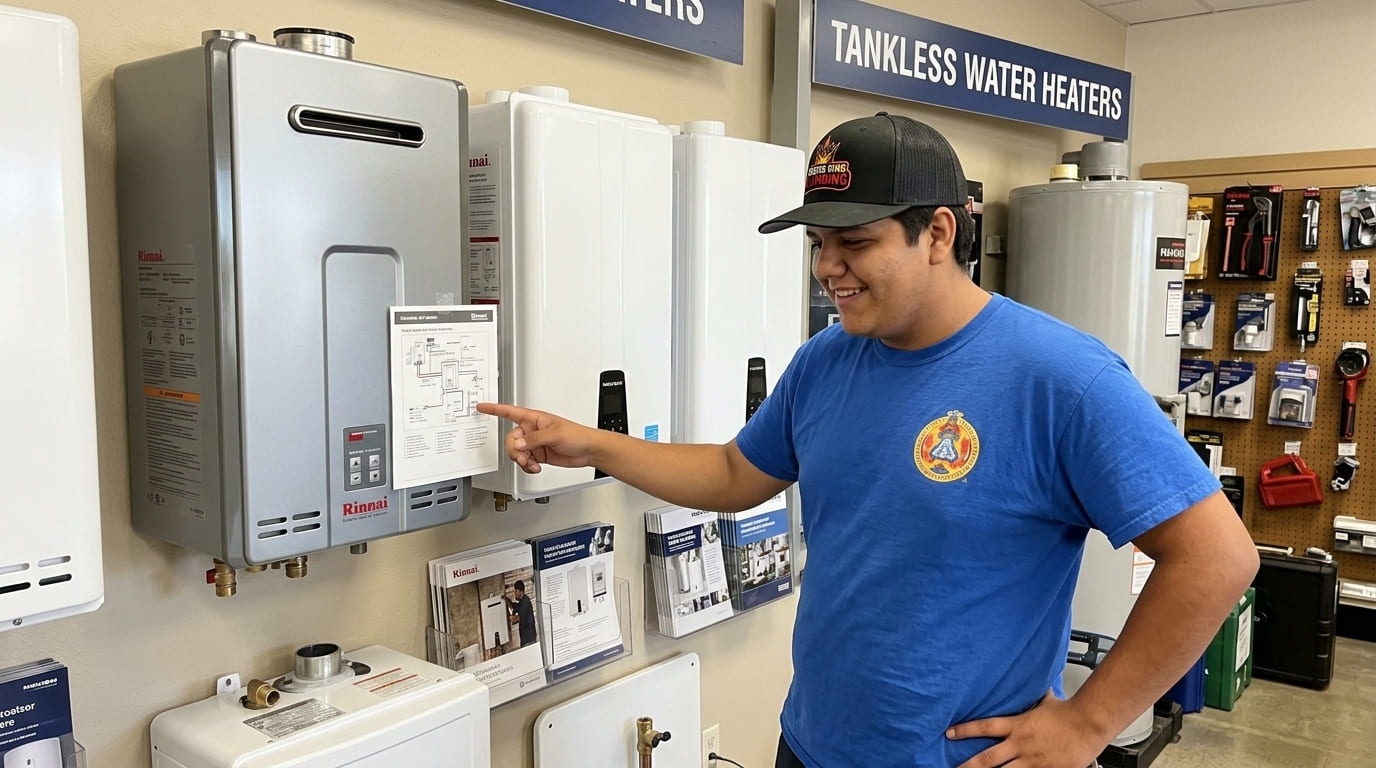
Tankless Water Heater Conversion: Endless Hot Water + 24-34% Energy Savings
If your old tank is failing and you are looking to truly modernize your home, Rooter King highly recommends upgrading to a tankless water heater. These modern, wall-mounted units are completely revolutionizing how Riverside County residents think about their home plumbing.
Unlike a traditional heater that constantly burns energy 24/7 to keep a giant 50-gallon tank of water hot just in case you need it, a tankless unit (also known as an “on-demand” heater) only activates when you physically turn on a hot water tap. High-powered gas burners or electric coils instantly superheat the water as it passes through a heat exchanger, delivering it straight to your shower or appliance.
The benefits of upgrading to a tankless system are massive:
Double the Lifespan: While traditional tanks last about a decade, a well-maintained tankless unit can easily last 20 years or more, making it a fantastic long-term investment for your property.
Endless Hot Water: Because there is no tank to empty, you literally never run out of hot water. You can run the dishwasher, start the washing machine, and have two family members take showers at the exact same time without the water ever running cold.
Significant Space Savings: Traditional tanks are massive space hogs that take up valuable real estate in your garage or utility closet. Tankless units are roughly the size of a small carry-on suitcase and are cleanly mounted directly to your wall, freeing up square footage.
Massive Energy Savings: Because you are not paying to heat water while you are asleep or away at work, tankless units are incredibly energy efficient. According to the Department of Energy, homes that use 41 gallons or less of hot water daily can be 24%–34% more energy-efficient with demand water heaters than with conventional storage tank water heaters.
Decoding Common Water Heater Error Codes (Rheem, Rinnai, Navien, & More)
Staring at a digital display flashing a random number, or a little red light blinking on an old gas tank, is incredibly frustrating. It feels like your water heater is speaking an alien language. But those codes are actually the machine’s way of crying out for help.
When Riverside County homeowners frantically search Google for “what does this water heater error code mean,” they are usually dealing with one of the major brands. Here is a human-friendly breakdown of the most highly searched error codes and what they actually mean for your plumbing:
Rheem & Ruud Water Heaters Error Codes
Rheem is one of the most common brands found in Southern California homes.
- Code 11 (Tankless): Ignition Failure. The unit is trying to light the gas burner but failing. This could mean your gas is turned off, the igniter is dirty, or the gas valve is failing.
- Code 12 (Tankless): Flame Failure. The heater lights up, but the flame immediately goes out. Usually, this means the flame rod (the sensor that detects the fire) is coated in carbon buildup and needs to be professionally cleaned or replaced.
- Code 29 (Tankless): Heat Exchanger Maintenance. This is a huge one in our area. It means the unit has detected a massive buildup of hard water scale inside the heat exchanger. The unit needs an immediate, professional chemical flush before it completely overheats and breaks.
- Flashing Red Light (Standard Tanks): If you have a traditional gas tank, the honeywell gas valve often has a status light.
- 1 Flash every 3 seconds: Normal operation.
- 2 Flashes: Low thermopile voltage (the pilot light is too weak to generate the electricity needed to open the gas valve).
- 4 Flashes: High-temperature limit switch tripped. The water got dangerously hot, and the system shut itself down to prevent an explosion. Do not try to reset this yourself without a plumber checking the thermostat first.
Rinnai Tankless Water Heater Error Codes
Rinnai units are fantastic, but they are highly sensitive to water quality and gas pressure.
- Code 11: No ignition. Just like Rheem, the unit isn’t getting gas or the spark isn’t firing.
- Code 12: Flame failure. The burner lights but won’t stay lit.
- Code LC (or LC00 – LC09): Scale Build-up. This code specifically means the unit is choked with calcium and magnesium from Riverside’s hard water. “LC” stands for Limiting Condition. If you see this, call Rooter King to perform a descaling flush immediately to restore efficiency.
- Code 10: Air supply or exhaust blockage. Something (like a bird’s nest or heavy debris) is blocking the exhaust pipe on your roof or the side of your house, causing a dangerous backup of carbon monoxide.
Navien Tankless Water Heater Error Codes
Navien units feature highly detailed digital displays that make diagnostics slightly easier.
- Error E003: Ignition failure. The spark igniter or the gas supply is compromised.
- Error E030: Exhaust overheat. The exhaust gas temperature has gotten way too high. This often happens if the unit hasn’t been flushed and the heat exchanger is working too hard to push through scale buildup.
- Error E046: Heat exchanger thermistor abnormality. Again, this almost always points back to a lack of routine maintenance and severe hard water scaling that is confusing the temperature sensors.
A.O. Smith & Bradford White (Standard Tanks) Error Codes
These classic brands often use a blinking LED light on the gas control valve to communicate issues.
- 3 Flashes: Draft failure. The sensor detects that the exhaust gases are not safely venting up the chimney or flue pipe, creating a massive carbon monoxide hazard in your home.
- 7 Flashes: Flammable vapor sensor lockout. The water heater has detected flammable vapors (like spilled gasoline, paint thinner, or heavy cleaning chemicals) in the air near the unit and has permanently locked itself out to prevent a house fire. Never try to bypass this safety feature.
Disclaimer: Error codes are a diagnostic starting point. Messing with gas lines, high-voltage electricity, or carbon monoxide venting without a license is incredibly dangerous. If your unit is throwing codes, shut it off and call the professionals at Rooter King.
Testimonial Of The Month
5-Star Service = 5-Star Reviews
What Riverside County Hard Water Does to a Tankless Heat Exchanger
Hard water is the single biggest factor in how long a tankless heater lasts in the Inland Empire. The municipal supply here carries a heavy load of dissolved calcium and magnesium, and a tankless unit concentrates the effect, because every drop of hot water the house uses passes through one narrow heat exchanger rather than sitting in a large vessel.
According to data from the U.S. Geological Survey (USGS), the supply reaching Riverside County homes is famously hard, and the minerals it carries are harmless to drink but punishing to an on-demand heater. Where a storage tank simply collects sediment on its floor and keeps going, a tankless unit plates that mineral directly onto the surfaces that do the heat transfer.
When hard water is driven through a tankless exchanger and the burner fires, calcium comes out of solution and bonds to the hottest metal it can reach, which is the wall of the exchanger passage itself. Those passages are deliberately narrow, because that is what makes the unit efficient, and it is the same reason even a thin coating of scale matters so quickly here.
Scale chokes the flow and insulates the metal at the same time. The burner runs longer to deliver less heat, the unit begins throwing limiting-condition and exhaust-temperature faults, and the exchanger fatigues from working against its own coating. That is why every tankless system in Riverside County needs a periodic descaling flush, and why Rooter King fits isolation service valves on the installs we do, so the flush stays a routine visit instead of a teardown.
Schedule Your Tankless Conversion Today!
Whole-House vs. Point-of-Use Tankless: Sizing Your System
When a tankless unit is going in, the first question is not the brand on the front. It is the fuel. A gas tankless heater and an electric tankless heater solve the same problem in very different ways, and which one suits your home depends on the gas capacity at the meter, the service in your electrical panel, and where the unit can physically hang and vent.
Natural Gas Water Heaters Gas tankless heaters are the common choice in Southern California homes, where natural gas is already at the meter and the rest of the appliance load is built around it.
The Cons: A gas tankless unit usually costs more to put in than an electric one. It needs sealed, code-compliant venting to carry combustion gases out of the building, and it often needs a larger gas line than the old tank ever required, because it fires hard in short bursts instead of gently over hours.
The Pros: What that buys you is output. A gas tankless heater can hold temperature through a shower and a dishwasher at once, and it does not run out the way a tank does; the limit is flow rate, not gallons. For a household that showers back to back, that is the whole argument for gas.
Electric tankless heaters pass water across resistance elements as it flows, with no storage vessel and no combustion at all, which is why they need no flue or vent.
- The Pros: Electric units cost less to buy and are far easier to site. With no venting to route, they fit under a sink, inside a closet, or right at a single distant fixture, which makes them a sensible answer for an addition, a casita or a remote bathroom rather than for the whole house.
- The Cons: The catch is the panel. A whole-home electric tankless heater draws heavily enough that many older Riverside County services cannot carry one without a costly upgrade, California electricity generally costs more per unit of delivered heat than gas does, and a power cut takes your hot water with it.
Rooter King will look at your gas line, your panel, your vent route and the way your household actually draws hot water, then tell you plainly which tankless configuration fits the house, or whether a storage tank is honestly the better answer for it.
NEED WATER HEATER SERVICES? CONTACT US TODAY!
Tankless Water Heater — Riverside County Service Areas
Rinnai, Navien, and Noritz tankless installs, gas line upsize, and annual descaling. Pick your city for local availability and IRA tax credit details.
Tankless Water Heater in Corona, CA
Rinnai & Navien tankless install.
Tankless Water Heater in Eastvale, CA
Whole-house tankless conversion.
Tankless Water Heater in Norco, CA
Gas line upsize for tankless.
Tankless Water Heater in Jurupa Valley, CA
Annual descaling & service.
Tankless Water Heater in Riverside, CA
Condensing tankless install.
Tankless Water Heater in Palm Springs, CA
IRA $2K tax credit eligible.
Tankless Water Heater in Palm Desert, CA
Combi-boiler & high-output GPM.
Tankless Water Heater in Rancho Mirage, CA
Endless hot water upgrade.
Tankless Water Heater in Indian Wells, CA
Concierge tankless install.
Tankless Water Heater in Bermuda Dunes, CA
Tankless swap, vent & gas work.
Tank vs. Tankless
Is a Tankless Water Heater Right for You?
How a tankless unit compares to a traditional tank — so you can pick with confidence.
| Factor | Tank (Traditional) | Tankless |
|---|---|---|
| Upfront cost | $1,500–$3,000 | $3,000–$5,500 |
| Lifespan | 8–12 years | 20+ years |
| Hot water | Limited by tank size | Endless, on demand |
| Energy use | Reheats around the clock | Heats only when you need it |
| Space | Large floor unit | Compact wall-mount |
| Best for | Lower upfront budget | Long-term savings & space |
Tankless Water Heater FAQs
How long does a tankless water heater last?
With routine maintenance, a tankless unit typically lasts 20+ years — roughly double the lifespan of a standard tank. They also come with longer manufacturer warranties.
Will a tankless heater really give me endless hot water?
Yes. Tankless units heat water on demand, so you never run out mid-shower. The key is correct sizing — we calculate the right flow rate for your home so multiple fixtures can run at once.
Is a tankless water heater worth the higher upfront cost?
For most Coachella Valley and Riverside County homes, yes. You save on energy every month, gain back closet or garage space, and the unit outlives two traditional tanks — so it often pays for itself over its life.
Do tankless water heaters need maintenance?
They should be descaled (flushed) about once a year, especially here where the water is very hard. We offer maintenance plans that keep your warranty valid and your unit running at full efficiency.
Can you replace my old tank with a tankless unit?
Absolutely. A tank-to-tankless conversion may need gas line or venting upgrades, and we handle all of that — including permits and inspection — so it’s done to code.
How long does installation take?
Most straightforward installations are completed the same day. A conversion with gas or venting changes may take a little longer, and we’ll give you a clear timeline up front.
Contact Rooter King
Ready to Go Tankless? Call Today
Endless hot water, lower bills, and a 20-year unit. Get a tankless quote from our Riverside County team.
Call (951) 880-3727Request a Time24/7 emergency line · CSLB #1090875 · 5.0★ on Google
Our Service Area
Frequently Asked Questions
Is a tankless water heater worth it?
For many SoCal homes, yes. Tankless units provide endless hot water, take up less space, and last longer than tank heaters, though they cost more up front.
Will a tankless heater give my whole house hot water?
A properly sized unit can run multiple fixtures at once. We size the heater to your home flow rate and number of bathrooms.
Do tankless water heaters need maintenance?
Yes. In hard-water areas like the Inland Empire, we recommend descaling once a year to keep the unit efficient and under warranty.
Can you convert my tank heater to tankless?
Yes. We handle the gas, venting, and water connections needed to convert from a tank to a tankless system, with permits and inspection.
COMPARE BEFORE YOU BUY
Tankless is not automatically the right answer. The hub compares both system types and explains how each is sized.