 Skip to content

TRENCHLESS * FULL REPLACEMENT * 100-YEAR HDPE
PIPE BURSTING – REPLACE THE WHOLE LINE. NO TRENCH.
When the camera shows a sewer line that’s too far gone for lining, pipe bursting is the trenchless answer. A bursting head fractures the old pipe outward while pulling a new smooth HDPE pipe in behind it — through just two small access pits.- 100+ year service life on smooth HDPE pipe
- Two small pits — no continuous trench
- Can upsize pipe diameter for added capacity
- Most residential jobs are done in 1–2 days
Always On Time & On Budget. Licensed · CSLB- #1090875
NO TRENCH – 100 YEAR PIPE
GET A FREE BURSTING QUOTE
Camera inspections & flat-rate replacement quote – no obligation.OR
WHAT IS PIPE BURSTING?
THE BASICS – WHAT IS IT?The trenchless way to fully replace a sewer line — even when CIPP isn’t an option.
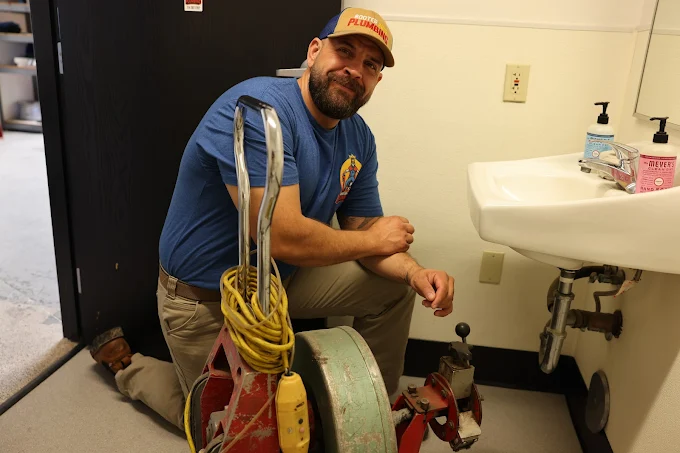
Pipe bursting is a trenchless method for fully replacing a damaged underground sewer pipe. A hydraulically- or pneumatically-driven bursting head is pulled through the existing pipe, fracturing the old pipe outward into the surrounding soil. At the same time, a new smooth high-density polyethylene (HDPE) pipe is towed behind the bursting head, replacing the old line — all without digging a continuous trench. Rooter King Plumbing specializes in trenchless pipe replacement techniques. Pipe bursting is the best option when your pipes are failing and cannot be saved by other methods.
Unlike CIPP lining, which rehabilitates the inside of a pipe that retains its shape, bursting is the right answer when the host pipe is severely damaged, partially collapsed, or needs an increase in diameter. The new HDPE pipe is fusion-welded into a single continuous, smooth run with zero joints — which means zero root-entry points and a service life of 100+ years.
Total excavation: typically two small pits, one at each end of the line. Driveways, lawns, patios, and landscaping between the pits stay completely intact.

HOW PIPE BURSTING WORKS.
OUR PROCESS · STEP BY STEP01
Inspect & Plan
Camera and locating equipment confirm that bursting is the right fix and map the line. We mark the two access-pit locations (entry and exit).
02
Excavate Two Pits
Two small pits are dug — typically 3 ft × 4 ft each — one at each end. Everything between the two pits stays untouched.
03
Fuse New HDPE
A new HDPE pipe is heat-fused on-site into one continuous, jointless run sized to your line — or upsized by one nominal diameter.
04
Burst & Pull
A new HDPE pipe is heat-fused on-site into one continuous, jointless run sized to your line — or upsized by one nominal diameter.
Replace The Whole Line — Without The Trench.
SIGNS YOU NEED PIPE BURSTING
DIAGNOSTICS – DO YOU NEED THIS?Bursting is the trenchless option when lining isn’t possible. Here’s how we know on the camera.
Ideal Pipe-Bursting Scenarios:
- Partial or complete pipe collapse
- Multiple major fractures along the line
- Severe bellies, sags, or back-pitch
- Pipe diameter undersized for the property
- Adding an ADU that needs more flow capacity
- Orangeburg pipe that’s deformed beyond lining
- Failed earlier patches or lining attempts
- Sewer-line replacement required by inspection
GOT A WRITTEN ESTIMATE? FREE 2ND OPINION
PIPE BURSTING VS OTHER OPTIONS
COMPARE – SIDE-BY-SIDE| Factor | Pipe Bursting | CIPP Lining | Traditional Dig |
|---|---|---|---|
| Replaces vs. lines | Full replacement | Rehabilitates host | Full replacement |
| Pipe condition required | Any (even collapsed) | Must hold shape | Any |
| Diameter increase | Yes (up one size) | No | Yes |
| New pipe material | smooth HDPE | Cured epoxy/fiberglass | Typically ABS/PVC |
| Excavation footprint | Two small pits | None | Full trench |
| Service life | 100+ years | 50+ years | 50+ years |
| Time on site | 1–2 days | 1 day | 2–10 days |
WHY CHOOSE ROOTER KING FOR PIPE BURSTING?
Hydraulic Bursting Rigs
We own the equipment — we don’t subcontract. No middleman, no delay, no markup.
On-Site HDPE Fusion
SuPipe is fused on your property to the exact length, eliminating joints from the run. Support special exhibitions.
Utility Locates First
Every burst starts with full utility locates — gas, water, electric, and telecom — so nothing gets by surprise.
Flat-Rate Pricing
One quote, locked. We’ll beat any other written pipe-bursting estimate, guaranteed.
Yard-Friendly Crews
We tarp, protect, and restore. Driveways are saved. Landscaping returned to grade.
Manufacturer Warranty
HDPE pipe carries a 50-year manufacturer warranty. We back our install with workmanship warranty in writing.
GOT TREE ROOTS IN YOUR SEWER LINE?
Testimonial Of The Month
5-Star Service = 5-Star Reviews
PIPE BURSTING FAQS
Pipe Bursting FAQs
What is pipe bursting?
Pipe bursting is a trenchless method for fully replacing a damaged underground sewer pipe. A bursting head is pulled through the old pipe, fracturing it outward into the surrounding soil while a new smooth HDPE pipe is towed in behind — without digging a continuous trench.
When is pipe bursting the right choice over CIPP lining?
Bursting is preferred when the existing pipe is severely damaged, partially or fully collapsed, or when a diameter increase is needed. CIPP requires the host pipe to hold its shape; if the camera shows total failure or extreme deformation, bursting is the better trenchless option.
How long does pipe bursting take?
Most residential bursting projects are completed in 1–2 days, including camera, excavating the entry and exit pits, the burst itself (typically 1–3 hours of pulling), lateral reconnections, and backfill. The line is back in service the same day as the burst.
How long does the new HDPE pipe last?
HDPE sewer pipe installed via bursting carries a documented service life of 100 years or more. HDPE is fusion-welded into a single smooth run with no joints — making it highly resistant to root intrusion, corrosion, and ground movement.
Will my yard, driveway, or landscaping be torn up?
Pipe bursting requires only two small access pits — one at each end — typically 3 by 4 feet each. The rest of the line is replaced underground with no continuous trench. Driveways, patios, and lawns between the pits stay intact.
Can pipe bursting increase pipe diameter?
Yes. One major advantage of bursting over CIPP lining is the new HDPE pipe can match the original size or be upsized by one nominal diameter (e.g. 4″ to 6″) to add flow capacity for additions, ADUs, or commercial buildouts.
Does pipe bursting work under driveways and slabs?
Yes — that’s one of its strengths. Burst the line from a pit on either side of the obstruction and the driveway or slab stays in place.
Contact Rooter King
Replace The Line Without The Trench — Call Today
Pipe bursting pulls a new line straight through the old one, so you get full-size pipe without opening the whole run. Licensed, 5-star rated, available 24/7.
Call (951) 880-3727Request a Time24/7 emergency line · CSLB #1090875 · 5.0★ on Google
Our Service Area
WHY PIPE BURSTING SUITS INLAND EMPIRE PROPERTIES
Bursting earns its place here because of how local lots are built and planted. Established neighbourhoods in Corona, Norco and Riverside have mature trees along the same easements the sewer runs through, deep driveways, and a great deal of concrete and stamped hardscape between the house and the street. Norco large equestrian parcels add a further wrinkle: laterals there can be long, and the ground above them is in daily use. Trenching a line like that is not just expensive, it takes the property out of service.
Replacing the pipe along its existing path, through two access pits rather than an open trench, keeps almost all of that intact. The decision is not automatic, though, and the rest of this page covers the conditions that make it the right call and the ones that rule it out.
EXPANSIVE CLAY AND THE CASE FOR A FUSED LINE
The replacement pipe pulled into place is high density polyethylene, joined by heat fusion so that each length becomes continuous with the next. The joins are made on site and, done correctly, the finished line has no couplings along its length. That single property is what makes it well matched to the ground it sits in.
Expansive clay across western Riverside County swells as it takes up moisture and shrinks as it dries, and that movement is what opens joints in older jointed pipe. A line assembled from short jointed sections has a weak point every few feet, and those are precisely the places where sections step out of alignment and where fine roots find their way in. A continuously fused line has none of those openings, and polyethylene flexes with ground movement instead of resisting it the way brittle clay does.
NO JOINTS TO OPEN
Heat-fused polyethylene has no couplings along its length, removing the points where soil movement creates offsets.
FLEXES WITH THE GROUND
Polyethylene bends rather than cracking, which suits soil that changes volume between wet and dry seasons.
NOTHING FOR ROOTS
Roots enter through gaps at joints and cracks. A continuous line gives them no entry to exploit.
DIAMETER OPTIONS
Because the old pipe is displaced outward rather than relined, the replacement can match or exceed the original bore.
WHAT HAS TO BE TRUE BEFORE WE BURST
Bursting is a good method, not a universal one, and the honest answer on some lines is that it will not work. Before quoting we camera the line, locate it along its length, and confirm what else is buried near it. The table below sets out what we are checking and why each item matters.
One local factor deserves its own mention. Heavily scaled and tuberculated cast iron is common in older Inland Empire building drains, and it often decides the method. Relining requires cutting that buildup back to sound pipe wall first, and where corrosion has taken too much of the wall, there is not enough left to line against. Bursting sidesteps the question entirely by replacing the pipe rather than working inside it, which is frequently why it is chosen over a liner on cast iron.
FEASIBILITY CHECK
CONDITIONS THAT DECIDE WHETHER BURSTING WORKS
What we confirm before recommending the method, and what each finding changes about the plan.
| Condition | Why it matters | What we do about it |
|---|---|---|
| A complete collapse in the line | The bursting head needs a continuous path to follow | Excavate and repair the collapsed section, then burst the remainder |
| Other utilities running close alongside | Displaced soil can disturb gas, water or conduit nearby | Utility locates first; where clearance is short, open cut that stretch instead |
| Severe bellies along the run | Bursting follows the existing path, including its sags | Correct the grade by excavating that section; bursting alone will not fix fall |
| Very shallow cover near the surface | Soil displacement can lift or crack what sits above | Assess cover depth and switch method where the line runs too close to the surface |
| Access for two pits | Entry and exit pits are what replace the trench | Site them at the cleanout and near the connection to limit surface disruption |
| Heavily corroded cast iron | Too little sound wall remains to line against | A strong indication for bursting rather than a cured-in-place liner |
PERMITS, THE PUBLIC RIGHT OF WAY AND YOUR NEIGHBOURS
A full lateral replacement is permitted work everywhere in this region, and the issuing agency follows the address. Inside an incorporated city the permit comes from that city building department; the City of Norco, for example, handles building permits through its own departments, as do Corona, Riverside, Eastvale and Jurupa Valley. Property in unincorporated Riverside County is permitted through the county building and safety department instead.
There is usually a second permit. If the work has to reach the main under a sidewalk, kerb or roadway, that portion sits in the public right of way and normally needs an encroachment permit from whichever agency maintains the street, which may be the city or the county depending on the road. Where a lateral runs beneath a shared driveway or a neighbour easement, access should be arranged in advance rather than on the morning of the work. We confirm the jurisdiction and pull what is required as part of the job.
WHAT THE PROPERTY LOOKS LIKE AFTERWARD
The honest description is two pits and a line of settled ground, not an untouched lawn. Pits are typically opened at each end of the run, and the ground along the path may settle slightly as displaced soil consolidates over the following weeks. Turf over the route can show the line for a season. What you avoid is the continuous open trench, and with it the removal and replacement of driveway, walkway or mature planting along its whole length.
We backfill and compact the pits, restore hard surfaces that were cut for access, and tell you plainly beforehand which surfaces cannot be put back exactly as they were. If a section has to be open cut because one of the conditions above rules bursting out, you will know that at quotation rather than discovering it once the work has started.
PIPE BURSTING QUESTIONS FROM INLAND EMPIRE PROPERTY OWNERS
Why choose a fused line for soil that moves?
Because the failures caused by expansive clay happen at joints. Ground that swells and shrinks steps jointed sections out of alignment and opens gaps that roots follow. Heat-fused polyethylene has no couplings along its length and flexes with the ground instead of resisting it, so the defect that clay soil normally produces has nowhere to form.
Can every line be burst?
No, and we check before quoting rather than after starting. A total collapse leaves no path for the head to follow, severe bellies will be reproduced rather than corrected, very shallow cover risks lifting what sits above, and utilities running close alongside may not have safe clearance. Any of those can mean open cutting part or all of the run.
Will bursting fix a sagging section?
Not by itself. The new pipe follows the path of the old one, so a belly in the existing line becomes a belly in the replacement. Correcting fall means excavating and re-grading that section. This is why the camera inspection and locate matter before the method is chosen.
Why is bursting often recommended over lining on old cast iron?
Lining works inside the existing pipe, so the pipe has to be sound enough to line against and must first be descaled back to bare wall. Where corrosion has consumed too much of that wall, there is not enough left to bond to. Bursting replaces the pipe outright, which avoids the problem.
Which agency issues the permit?
It follows the address. Incorporated cities such as Norco, Corona, Riverside, Eastvale and Jurupa Valley permit through their own building departments, while unincorporated county property is permitted by Riverside County. If the work reaches the main beneath a sidewalk or street, an encroachment permit from the agency maintaining that road is normally required as well.
How much of my yard will be disturbed?
Two access pits and a line of ground along the route, rather than a continuous open trench. The path may settle slightly over the following weeks as displaced soil consolidates, and turf can show the line for a season. Driveways, walkways and mature planting along the run generally stay in place.