 Skip to content

TRENCHLESS *STRUCTURAL * 50-YEAR LIFE
CIPP PIPE LINING – A NEW PIPE INSIDE THE OLD ONE.
Cured-in-place pipe lining rebuilds your sewer line structurally — without breaking ground. A resin-saturated liner is installed, inflated, and cured into a jointless new pipe rated for 50+ years of service. Most jobs done in a day.- ASTM F1216 compliant · 50-year service life
- Cast iron, clay, Orangeburg, PVC — all linable
- Most residential jobs are done in one day
- We’ll beat any written estimate
Always On Time & On Budget. Licensed · CSLB- #1090875
50-YEAR SERVICE LIFE
GET A FREE CIPP QUOTE
Camera inspections & flat-rate replacement quote – no obligation.OR
WHAT IS CIPP LINING?
THE BASICS – WHAT IS IT?Industry jargon, decoded. Here’s exactly what cured-in-place pipe lining is and how it differs from patching or replacement.
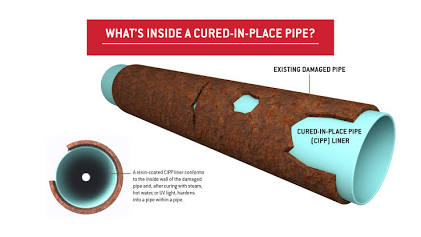
CIPP — short for “cured-in-place pipe” — is a trenchless method for structurally rebuilding a damaged sewer or drain pipe from the inside. A flexible felt or fiberglass liner is saturated with two-part epoxy resin, inserted into the host pipe through an existing cleanout, and inflated tight against the pipe wall using air or water pressure.
The resin then cures — using ambient temperature, hot water, steam, or UV light — into a hard, jointless “pipe within a pipe.” The cured composite is a standalone structural pipe, meaning it doesn’t rely on the old host pipe for strength. CIPP installations are rated to ASTM F1216 and carry a documented service life of 50 years or more.
Unlike a patch repair, which fixes just one short section, CIPP rehabilitates the entire length of the line — typically a full sewer lateral from the cleanout to the city main.

HOW CIPP LINING IS INSTALLED.
OUR PROCESS · STEP BY STEP01
Inspect & Clean
Camera inspection confirms CIPP is the right fix. The line is then hydro-jetted and descaled so the resin bonds tightly to a clean host wall.
02
Measure & Saturate
The liner is cut to exact length and diameter, then saturated with two-part epoxy resin under controlled conditions in our truck.
03
Insert & Inflate
The liner is inverted or pulled into the pipe through the cleanout, then inflated with air or water pressure to press it tight against the host pipe wall.
04
Cure & Verify
Resin cures via ambient temp, hot water, steam, or UV light — typically 1–4 hours. Final camera pass verifies a smooth, jointless new pipe.
Fix Pipes Without the Mess – Call Today!
SIGNS YOU NEED CIPP LINING
DIAGNOSTICS – DO YOU NEED THIS?Bursting is the trenchless option when lining isn’t possible. Here’s how we know on the camera.
Ideal CIPP Scenarios:
- Multiple cracks or fractures along the line
- Heavy root intrusion at several joints
- Aging cast iron with widespread corrosion
- Orangeburg (tar-paper) pipe deformation
- Clay tile with cracked or offset joints
- Calcium/scale buildup throughout
- Slab-encased pipe (no-dig access needed)
- Pipe still holds shape (not fully collapsed)
GOT A WRITTEN ESTIMATE? FREE 2ND OPINION
CIPP vs. OTHER OPTIONS
COMPARE – SIDE-BY-SIDE| Factor | CIPP Lining | Pipe Bursting | Traditional Dig |
|---|---|---|---|
| Excavation needed | None | Two small pits | Full trench |
| Pipe condition required | Holds its shape | Any Condition | Any Condition |
| Diameter increase | Slightly smaller | Same or larger | Same or larger |
| New pipe material | Cured epoxy/fiberglass | smooth HDPE | Typically ABS/PVC |
| Service life | 50+ years | 100+ years | 50+ years |
| Time on site | 1 Day | 1-2 days | 2–10 days |
| Property disruption | Minimal | Low | Heavy |
WHY CHOOSE ROOTER KING FOR CIPP LINING?
Certified Installers
Every CIPP tech is manufacturer-trained on liner saturation, inversion, and proper cure cycles.
NSF-61 Resins
We use only NSF-listed sewer-grade epoxy resins — no shortcuts on chemistry.
Pre/Post Camera
Before, during, and after camera passes. You get every video file in your inbox.
Flat-Rate Quotes
One price, locked. We’ll beat any other written CIPP estimate, guaranteed.
One-Day Turnaround
Most residential laterals are lined and cured the same day. Use water by evening in most cases.
Warranty In Writing
Workmanship warranty on every install. Manufacturer-backed material warranty included.
Testimonial Of The Month
5-Star Service = 5-Star Reviews
GOT TREE ROOTS IN YOUR SEWER LINE?
CIPP LINING FAQS
CIPP Pipe Lining FAQs
What is CIPP (cured-in-place pipe) lining?
CIPP is a trenchless method for rehabilitating damaged sewer pipes. A felt or fiberglass liner saturated with epoxy resin is inserted into the host pipe through a cleanout, inflated tight against the pipe wall, and cured (ambient, hot water, steam, or UV) into a jointless structural “pipe within a pipe” with a 50-year-plus service life.
How long does a CIPP liner last?
A properly installed CIPP liner has a documented service life of 50 years or more. Cured composites are tested to ASTM F1216 standards, and accelerated-aging studies suggest performance well beyond the 50-year benchmark.
What pipes can be CIPP lined?
Cast iron, clay, Orangeburg, concrete, ABS, and PVC — residential and commercial. Typical diameters are 2″–12″ for laterals (larger for mainlines). The host pipe must hold its shape; severely collapsed pipes require pipe bursting instead.
How long does CIPP installation take?
Most residential CIPP jobs are completed in a single day — 6–10 hours including camera, cleaning, install, cure, and reinstating laterals. You can use water that evening in most cases.
Does CIPP reduce the inside diameter?
CIPP liners are very thin — typically 3–6 mm of cured wall thickness. There’s a small ID reduction, but the smoother resin surface improves flow versus the corroded host pipe in nearly every case.
Will I have to dig up my yard or break concrete?
No. CIPP is fully trenchless — installation is through an existing cleanout or, in some cases, a single small access point. No driveway demo, no torn-up landscaping, no tunnel under the slab.
Does CIPP work for cast iron pipes?
Yes — CIPP is one of the most common methods to extend the life of corroded cast iron in pre-1980 SoCal homes. We typically descale first to remove scale, then line over the cleaned host pipe.

A NEW PIPE – IN A SINGLE DAY
50-year service life. Zero excavation. Flat-rate pricing. We’ll beat any written CIPP estimate. Call now to book a free inspection.
Contact Rooter King
Line Your Sewer, Keep Your Yard — Call Today
Cured-in-place lining forms a new pipe inside the old one, so the landscaping and driveway stay where they are. Licensed, 5-star rated, available 24/7.
Call (951) 880-3727Request a Time24/7 emergency line · CSLB #1090875 · 5.0★ on Google
Our Service Area