 Skip to content

Your sewer line gave up. Roots got in. A section collapsed. Or maybe three “rooter” companies have snaked the same blockage every six months and a camera scope finally showed the truth. The pipe is done.
Now your plumber hands you two options.
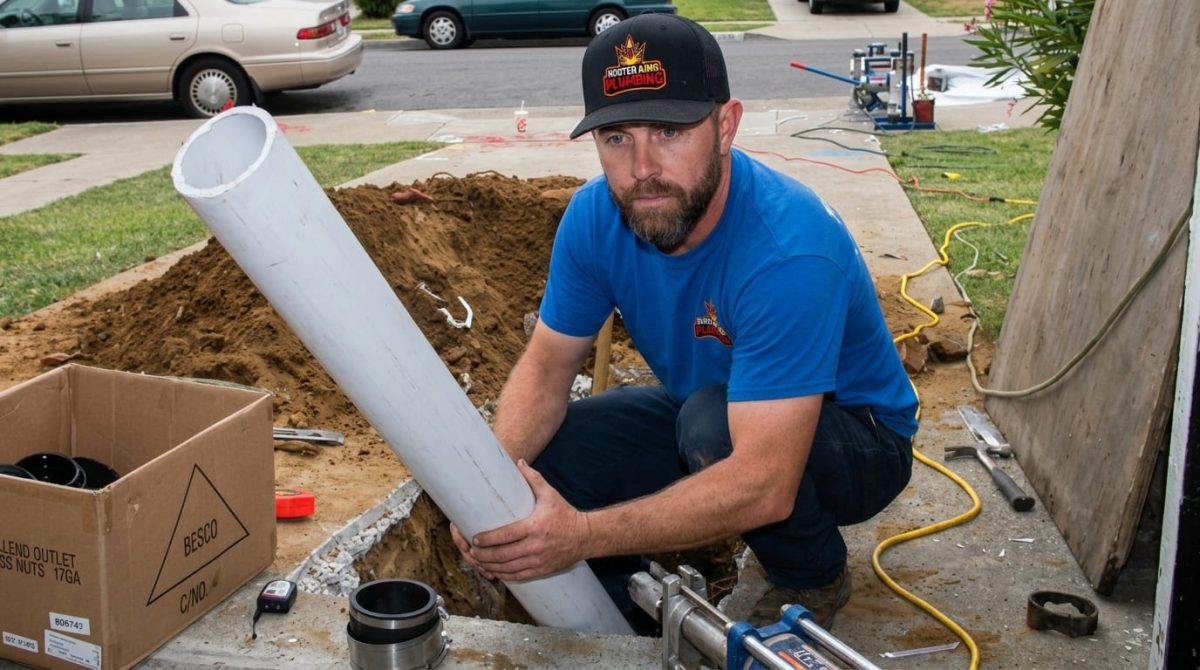
Option one: the old way. Open up the yard, dig down to the pipe, replace the bad section, fill it back in. Traditional excavation.
Option two: trenchless. Repair the line through two small access points. No big trench. No torn-up driveway.
Trenchless sounds great. The quote also looks bigger.
So which one actually saves you more money once everything is totaled up? The honest answer catches a lot of homeowners off guard.
What Trenchless Actually Means
Trenchless is the umbrella term for a few different methods. The two most common in residential work:
Pipe bursting. A new HDPE pipe gets pulled through the old one. The old pipe breaks outward as the new one goes through. You end up with a full replacement in the same path.
Cured-in-place pipe (CIPP) lining. A flexible liner soaked in epoxy resin gets inserted into the old pipe and inflated. The resin cures hard. You end up with a brand-new pipe inside the shell of the old one.
Both methods only need two small access pits. One near the house, one near the city tap. Everything in between stays untouched. Yard. Driveway. Sidewalk. Landscaping. All of it.
For a more technical overview, the Wikipedia article on trenchless technology walks through how the various methods work.
What Traditional Excavation Means
The way it’s always been done. A backhoe digs a trench from the house to the street along the sewer line. Pull the bad pipe out. Drop new PVC or ABS in. Backfill. Compact. Restore whatever was on top.
It’s proven. It’s also a much bigger project than most homeowners realize until it’s happening in their yard.
The Real Cost Comparison
Per linear foot in 2026 (national averages — Inland Empire pricing tracks within 5-10% of these):
- Traditional dig-up: $50 to $125 per linear foot
- Pipe bursting: $60 to $200 per linear foot
- CIPP lining: $80 to $250 per linear foot
At a glance, traditional looks cheaper. And on the line item for the pipe replacement itself, it usually is.
But here’s the part the homeowner doesn’t see until the work starts.
The Cost Nobody Talks About: Restoration
What’s on top of the pipe drives the total cost more than the pipe method itself.
If the line runs under plain lawn, restoration is cheap. Toss some sod down. Done.
If it runs under a poured concrete driveway, mature landscaping, hardscape pavers, a pool deck, or part of the street, restoration costs explode. We’re talking demolition, removal, hauling, re-pouring, restaining, replanting.
A 2026 cost analysis from NuFlow found that full restoration of landscaping and hardscaping after traditional dig-ups usually runs $2,000 to $6,000 for a typical residential job, and substantially more when a driveway has to be torn out and re-poured.
So the picture flips. A trenchless job that costs 30% more per foot on the pipe portion often comes in cheaper overall once restoration gets added in. The trenchless quote includes:
- No driveway demolition
- No new concrete pour
- No replacement sod or landscaping
- No tree removal
- No fence panels coming down
For a home with a sewer line running under a finished hardscape, the total job comes in 30 to 50 percent lower trenchless once restoration is in the math.
When Trenchless Is Almost Always the Right Call
You’ll come out ahead with trenchless when:
- The line runs under a concrete driveway, walkway, or patio
- Mature landscaping or expensive hardscape sits on top of the line
- The line crosses paved or stamped surfaces
- You want the work done in 1 to 2 days instead of 5 to 10
- You don’t want a backhoe in your front yard for a week
When Traditional Excavation Still Wins
Trenchless isn’t right for every job. The dig is the better answer when:
- The pipe is severely collapsed (bursting and lining both need a continuous path to follow)
- The line has multiple sharp bends or major changes in slope
- The pipe sits so deep that access pits would be enormous anyway
- You’re rerouting the line entirely instead of replacing in place
- It’s just lawn on top with no hardscape and no mature landscaping
In those cases, the trench actually costs less, both upfront and after restoration.
What an Honest Plumber Does Before Quoting
If anyone quotes you a sewer replacement without scoping the line first, walk away. Period.
A proper diagnosis includes:
- Video camera inspection from the cleanout
- Locating the line and marking it on the surface above
- Measuring depth and identifying obstructions or transitions
- Confirming the condition of the whole line, not just where the blockage is
Only then can a plumber tell you whether trenchless is even possible on your line. And whether it’ll actually save you money once restoration is factored in.
Warranty Differences
One more thing the cost comparisons usually skip. Trenchless installations typically come with longer warranties than traditional repairs. CIPP-lined pipe is often warrantied for 50 years. Pipe-burst HDPE has a similar projected service life. That doesn’t directly cut your project cost. It does change the math when you think about cost per year of service.
How Long Does the Job Actually Take?
Real-world timelines for a typical residential job:
- Traditional excavation: 5 to 10 days, depending on weather and what gets restored on top
- Pipe bursting: 1 to 2 days
- CIPP lining: 1 to 3 days
If you’re trying to host a holiday party next weekend, that timing difference matters.
Bottom Line for SoCal Homeowners
If your sewer line runs under finished hardscape, mature trees, or expensive landscaping, trenchless almost always wins on total cost. If it runs under plain lawn with nothing valuable on top, traditional excavation is usually the better move.
Don’t let anyone sell you one method without scoping the line first. The right answer depends on what’s between your house and the street. Not on which method the plumber prefers to sell.
Trusted Local Network
For homeowners outside SoCal handling broader home updates that include plumbing work, renovation services for permitted residential projects handle the broader scope. And for general handyman work that pairs with plumbing fixes, general handyman support covers related residential work.
Your Riverside Trenchless Sewer Specialists
Don’t let anyone sell you a sewer replacement method without scoping the line first. Rooter King Plumbing serves Riverside, Corona, Jurupa Valley, and Orange County. We run a video camera inspection on every sewer line before quoting any work, and we’ll tell you straight whether trenchless replacement and repair saves you more, or whether traditional excavation is right for your specific situation. Contact us today for a free assessment.