 Skip to content

A failing sewer line almost never blows up overnight. It warns you first — usually for months — in ways that are easy to write off as “just a slow drain.” By the time raw sewage is backing into a shower, the repair is bigger and more expensive than it had to be.
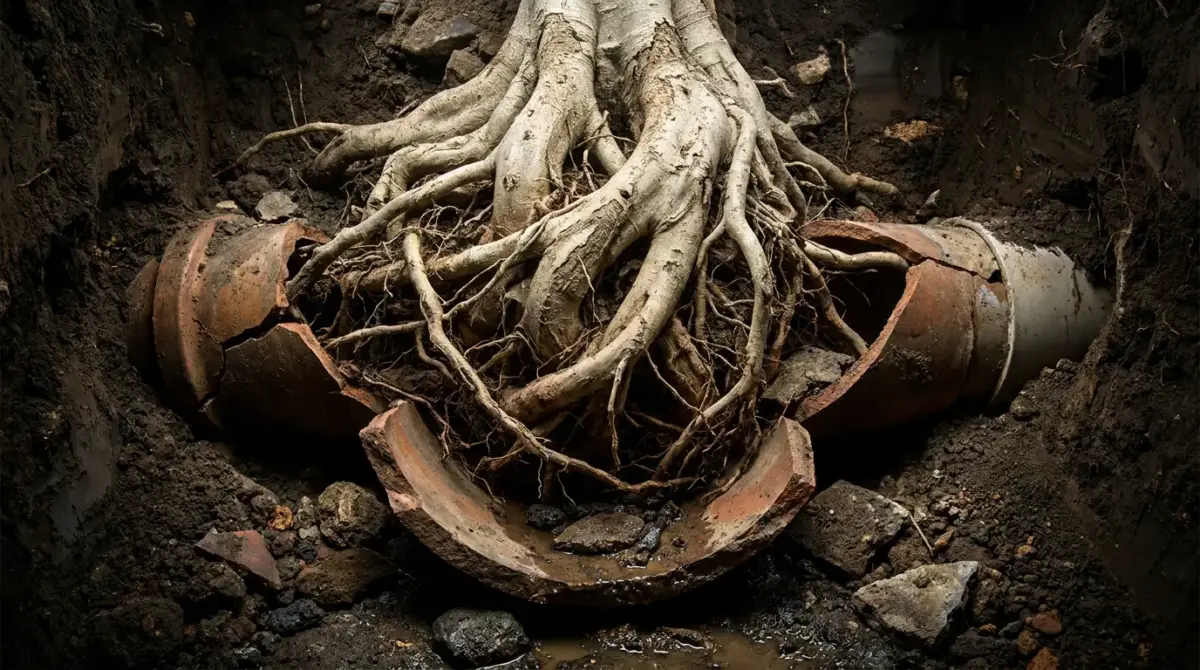
Here in Corona, Riverside, and across Riverside County, we see the same story every week: an older home, a clay or cast-iron lateral, a big shade tree in the front yard, and roots that have been quietly wrecking the pipe for years. The good news is that catching it early usually means we can fix it trenchless — no backhoe, no trench across your lawn, and often 30–50% less than a traditional dig once you count the cleanup.
Here are the seven signs worth acting on, what each one usually means, and what a replacement runs in 2026.
1. Multiple drains gurgle or back up at the same time
One slow sink is a local clog. Your toilet bubbling when the washing machine drains, or the shower backing up when you flush, is a main-line problem. When the whole house shares the symptom, the blockage or break is downstream in the main sewer line — not under a single fixture.
2. A recurring backup that keeps coming back after snaking
If a plumber snakes your line and it clears, then clogs again a few weeks later, the cable is just punching a hole through the problem. Roots grow back. A bellied (sagging) pipe keeps collecting waste. Recurring backups are the clearest sign the pipe itself — not just the clog — needs attention. This is exactly what a camera inspection is for.
3. Sewage smell inside or around the house
A properly sealed sewer system is airtight. If you’re catching a sewage or rotten-egg odor in a bathroom, the laundry room, or out in the yard, there’s a crack or a broken joint letting gas escape. Smell it outside near a specific spot in the yard? That’s often right over the failure.
4. A soggy or suspiciously lush patch in the yard
One of the most reliable signs, and the most missed. A leaking sewer line fertilizes the ground above it. If one strip of lawn is greener, taller, and softer underfoot than everything around it — especially with a faint odor — your sewer line is likely leaking right there.
5. Slow drains everywhere, even after cleaning
Not one slow drain — all of them. When every fixture in the house drains sluggishly, the restriction is in the shared line. Older Riverside County homes with original clay or cast-iron sewers are prime candidates; cast iron scales shut from the inside over decades (descaling can buy time, but a badly deteriorated pipe needs replacing).
6. Foundation cracks, sinkholes, or settling
A long-term sewer leak washes away the soil supporting your slab and foundation. Unexplained foundation cracks, a dip forming in the yard or driveway, or a section of hardscape that’s started to settle can all trace back to a leaking line underneath. This is the stage where waiting gets genuinely expensive.
7. An older home that has never had the line scoped
If your house is a few decades old and no one has ever put a camera down the sewer, you’re overdue. Clay, Orangeburg, and cast-iron laterals from that era are at or past their service life. A one-time inspection tells you whether you have five good years left or a problem forming — before it picks the worst possible moment to fail.
What sewer line replacement costs in 2026
Every line is different — length, depth, soil, and access all move the number — so treat these as planning ranges, not a quote. The only way to price your line is to scope it. That said, here’s what homeowners are actually paying:
Traditional dig-and-replace: The pipe work itself is often $4,000–$15,000, but the number that surprises people is restoration — rebuilding whatever sat on top of the line:
- New concrete or asphalt (if the line runs under a driveway): $2,000–$5,000+
- Landscaping, sod, and mature plants: $1,500–$4,000+
- Fencing or hardscape: $1,000–$3,000
Add it up and a traditional job commonly lands in the $6,500–$22,000+ range once the yard is put back together.
Trenchless replacement: Typically $80–$250 per linear foot, with most residential jobs around $6,000–$18,000. It’s a higher per-foot rate, but because we work through two small access points instead of a trench, you skip nearly all of the restoration cost — commonly 30–50% lower on the total project.
The two trenchless methods we use
- CIPP pipe lining — we cure a new pipe inside the old one. Best when the existing pipe still holds its shape.
- Pipe bursting — we pull a new pipe through the old one while breaking the old pipe outward. Best when the line is collapsed, badly offset, or you want to upsize.
Not every line qualifies for trenchless — a fully collapsed pipe or severe joint offsets can still require traditional excavation. We tell you which camp you’re in before you commit to anything.
Don’t guess — get eyes in the pipe
You don’t fix what you can’t see. Every one of these signs could be a $300 cleaning or a $12,000 replacement, and the only way to know is to put a camera down the line. Rooter King runs an HD sewer camera, shows you the footage on screen, and gives you a written, upfront quote. If a simple hydro jetting buys you years, we’ll tell you that too. See a recent trenchless sewer line replacement in Cathedral City.
Serving Corona, Riverside, Jurupa Valley, Norco, Eastvale, and the Coachella Valley — 24/7. Seeing one of these signs? Call Rooter King at (951) 880-3727 or book a camera inspection online. Licensed & insured · CSLB #1090875 · 5.0★ on Google.
Frequently asked questions
Can you replace a sewer line without digging up my whole yard?
In most cases, yes. Trenchless pipe bursting and CIPP lining replace or rehab the line through two small access points, preserving driveways, hardscape, and mature landscaping. We confirm your line is a trenchless candidate with a camera inspection first.
How long does trenchless sewer replacement last?
The cured-in-place and HDPE pipes we install are rated for 50+ years and are seamless, so there are no joints for roots to get back into.
How much does trenchless sewer replacement cost in Riverside County?
Most residential projects run about $6,000–$18,000 ($80–$250 per linear foot), depending on length, depth, and access. Because trenchless avoids concrete and landscaping restoration, the total is often 30–50% less than a traditional dig. We give you an exact, written quote after scoping the line.
Is trenchless always the right choice?
No — a fully collapsed pipe or severe joint offsets can require traditional excavation. That’s why we scope every line first and show you the footage before recommending a method.